Important Salesforce Certified MuleSoft Platform Architect (Mule-Arch-201) Exam Questions
Salesforce Certified MuleSoft Platform Architect (Mule-Arch-201) Exam
Attempt the Salesforce Architect practice test and solve real exam-like Salesforce Certified MuleSoft Platform Architect (Mule-Arch-201) questions to prepare efficiently and increase your chances of success. Our Salesforce Certified MuleSoft Platform Architect (Mule-Arch-201) practice questions match the actual Salesforce Certified MuleSoft Platform Architect exam format, helping you enhance confidence and improve performance. With our Salesforce Certified MuleSoft Platform Architect (Mule-Arch-201) practice exam software, you can analyze your performance, identify weak areas, and work on them effectively to boost your final Salesforce Architect exam score.
| Vendor: | Salesforce |
|---|---|
| Exam Name: | Salesforce Certified MuleSoft Platform Architect |
| Registration Code: | MuleSoft-Platform-Architect-I |
| Related Certification: | Salesforce Architect Certification |
| Exam Audience: | Salesforce Enterprise Architects, Salesforce Solution Architects, |
Total Questions
152
Last Updated
23-08-2026
Exam Duration
120 MINUTES
Upgrade to Premium
GET FULL PDFQuestion: 1
4 Production environment is running on a dedicated Virtual Private Cloud (VPC) on CloudHub 1,0, and the security team guidelines clearly state no traffic on HTTP.
Which two options support these security guidelines?
Choose 2 answers
Question: 2
How can the application of a rate limiting API policy be accurately reflected in the RAML definition of an API?
Question: 3
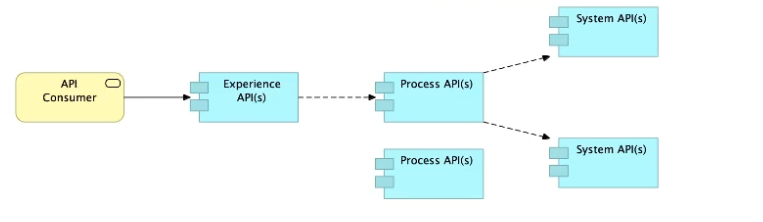
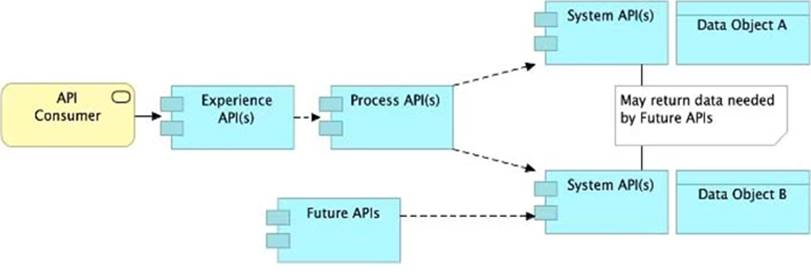
Refer to the exhibit.
What is the best way to decompose one end-to-end business process into a collaboration of Experience, Process, and System APIs?
A) Handle customizations for the end-user application at the Process API level rather than the Experience API level
B) Allow System APIs to return data that is NOT currently required by the identified Process or Experience APIs
C) Always use a tiered approach by creating exactly one API for each of the 3 layers (Experience, Process and System APIs)
D) Use a Process API to orchestrate calls to multiple System APIs, but NOT to other Process APIs
Question: 4
What is a typical result of using a fine-grained rather than a coarse-grained API deployment model to implement a given business process?
Question: 5
A Mule application exposes an HTTPS endpoint and is deployed to the CloudHub Shared Worker Cloud. All traffic to that Mule application must stay inside the AWS VPC.
To what TCP port do API invocations to that Mule application need to be sent?
Other Salesforce Certification Exams
Salesforce Certified Marketing Cloud Next Consultant
Salesforce Accredited Agentforce Financial Services Professional (AP-208) Exam
Salesforce Accredited Agentforce Financial Services Professional
Salesforce Certified Agentforce Sales Consultant (Sales-Con-201) Exam
Salesforce Certified Agentforce Sales Consultant
Salesforce Certified B2C Commerce Developer (Comm-Dev-101) Exam
Salesforce Certified B2C Commerce Developer
Salesforce Accredited Agentforce Communications Professional (AP-203) Exam
Salesforce Accredited Agentforce Communications Professional
Salesforce Certified Marketing Cloud Engagement Specialist (MC-202) Exam
Salesforce Certified Marketing Cloud Engagement Specialist