Important Arcitura Education S90.08B Exam Questions
Arcitura Education SOA Design & Architecture Lab with Services & Microservices S90.08B Exam
Attempt the SOA Certified Professional Gen 2 practice test and solve real exam-like S90.08B questions to prepare efficiently and increase your chances of success. Our Arcitura Education S90.08B practice questions match the actual SOA Design & Architecture Lab with Services & Microservices exam format, helping you enhance confidence and improve performance. With our S90.08B practice exam software, you can analyze your performance, identify weak areas, and work on them effectively to boost your final SOA Certified Professional Gen 2 exam score.
| Vendor: | Arcitura Education |
|---|---|
| Exam Name: | SOA Design & Architecture Lab with Services & Microservices |
| Registration Code: | S90.08B |
| Related Certification: | Arcitura Education SOACP Certification |
| Exam Audience: |
Question: 1
Refer to Exhibit.
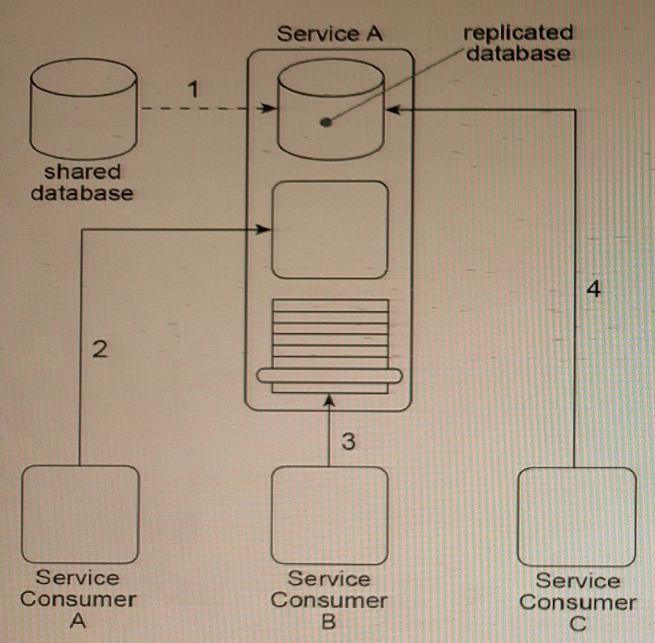
Service A is a utility service that provides generic data access logic to a database containing data that is periodically replicated from a shared database (1). Because the Standardized Service Contract principle was applied to the design of Service A, its service contract has been fully standardized.
The service architecture of Service A Is being accessed by three service consumers. Service Consumer A accesses a component that is part of the Service A Implementation by Invoking it directly (2). Service Consumer B invokes Service A by accessing Its service contract (3). Service Consumer C directly accesses the replicated database that Is part of the Service A Implementation (4).
You've been told that the reason Service Consumers A and C bypass the published Service A service contract is because, for security reasons, they are not allowed to access a subset of the capabilities in the API that comprises the Service A service contract. How can the Service A architecture be changed to enforce these security restrictions while avoiding negative forms of coupling?
Question: 2
Refer to Exhibit.
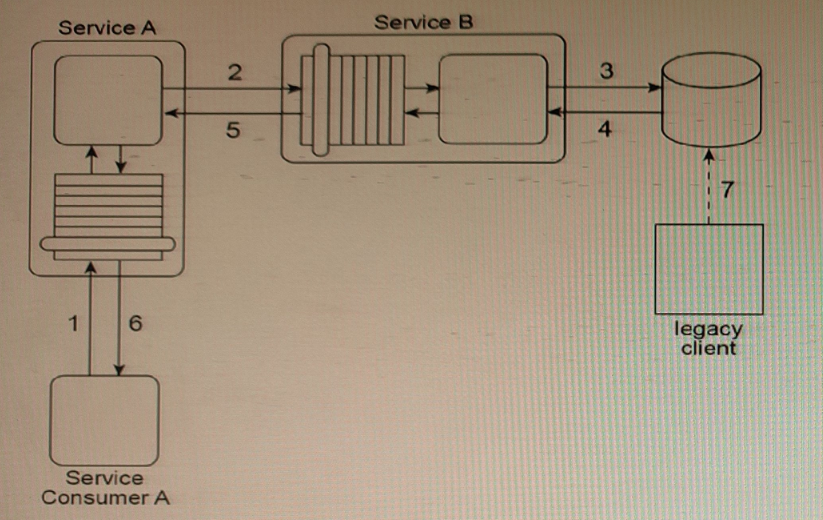
Service A is an entity service that provides a Get capability which returns a data value that is frequently changed.
Service Consumer A invokes Service A in order to request this data value (1). For Service A to carry out this request, it must invoke Service B (2), a utility service that interacts (3, 4) with the database in which the data value is stored. Regardless of whether the data value changed, Service B returns the latest value to Service A (5), and Service A returns the latest value to Service Consumer A (6).
The data value is changed when the legacy client program updates the database (7). When this change will occur is not predictable. Note also that Service A and Service B are not always available at the same time.
Any time the data value changes, Service Consumer A needs to receive It as soon as possible. Therefore, Service Consumer A initiates the message exchange shown In the figure several times a day. When it receives the same data value as before, the response from Service A Is ignored. When Service A provides an updated data value, Service Consumer A can process it to carry out its task.
The current service composition architecture is using up too many resources due to the repeated invocation of Service A by Service Consumer A and the resulting message exchanges that occur with each invocation.
What steps can be taken to solve this problem?
Other Arcitura Education Certification Exams
Advanced SOA Design & Architecture